Heavenly Host
Paradise LostThe Heavenly Host is the innumerable community of Angels ordered around God and the Son of God. It is at once a sacred assembly, a ranked political order, and an army: its members stand beneath distinct hierarchies and degrees, worship before the divine throne, defend Heaven, expel the Rebel Angels, and later attend the Son of God as he creates the world. Through the Host, the poem presents heavenly authority not as abstract power alone but as a visible order of allegiance, command, ritual, and collective action.
Nature and Organization
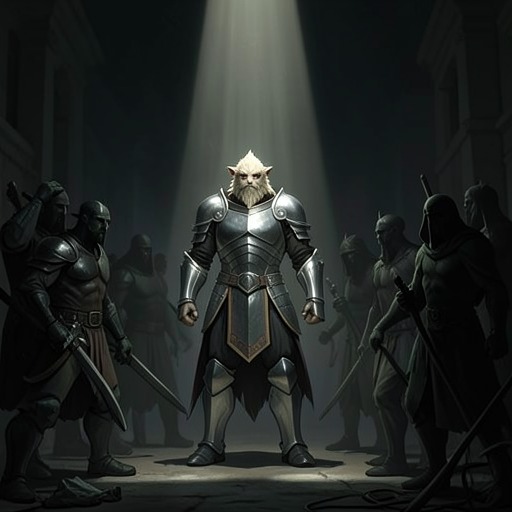
The Host appears before God’s throne in an immense ceremonial formation. Called together by imperial summons, it includes innumerable Angels arranged under their hierarchs, with ten thousand thousand standards and gonfalons raised in the air. The ensigns distinguish hierarchies, orders, and degrees, while also displaying memorials of zeal and love. The spectacle turns military organization into a sacred language: rank is not merely administrative but records service, devotion, and the place each order occupies within the celestial whole.
This hierarchy includes Thrones, Dominations, Princedoms, Virtues, and Powers, as well as Cherubim and Seraphim. The Host therefore combines a wide range of celestial orders without dissolving their distinctions. In the controversy over the appointment of the Son of God, Satan argues that the orders should remain compatible with equal freedom, while Abdiel answers that the Son’s headship does not diminish the glory of the Angels but unites and magnifies it. The Host’s structure consequently becomes the setting for a conflict over legitimate rule: whether freedom means independence from every superior authority or a willing participation in an order established by God.
The Host’s identity is also defined by shared worship. After God declares the Son of God to be his only Son and appoints him Head of Heaven, the Angels celebrate with song and mystical dance around the sacred hill. Their movement, intricate yet regular, resembles the ordered motions of the stars and becomes an image of harmony produced through differentiated ranks. They then gather for a heavenly feast of Angels’ Food, rubied Nectar, fruit, and wine, rejoicing before God. Ceremony, nourishment, music, and obedience all belong to the same social order.
Allegiance and the Heavenly Decree
The decisive political and theological crisis begins when God announces that the Son of God shall reign at his right hand and that every knee in Heaven shall bow to him. The decree makes obedience to the Son equivalent to obedience to God: resistance breaks the unity of Heaven and leads to exclusion from divine vision. The Heavenly Host is therefore not a neutral population surrounding the dispute. Its members are confronted with a choice between accepting the appointed Head and joining the argument for self-rule advanced by Satan.
Satan initially addresses the celestial ranks by presenting the decree as an imposed yoke. He claims that the Angels are equally free and were made to govern rather than serve, using the language of liberty to oppose monarchy. Abdiel alone answers him directly among the Seraphim. He defends the decree as just because the Son of God is the one through whom the Father created all things, including the Angels themselves. In Abdiel’s account, the Son’s reign does not obscure the orders or reduce their dignity; instead, it makes their honors more illustrious because the Head is one of their number and all honor given to him returns to the order he governs.
The response of the wider Host is significant. Abdiel’s zeal receives no seconding and is judged singular or premature, while Satan’s defiance is met by a deep murmur of approval. The Host thus contains both loyal obedience and a powerful susceptibility to rebellious rhetoric. Its organization cannot by itself guarantee faithfulness. The same ranks and titles that can express harmonious service can also be recruited into a political argument against divine authority.
The Heavenly Army and the War in Heaven
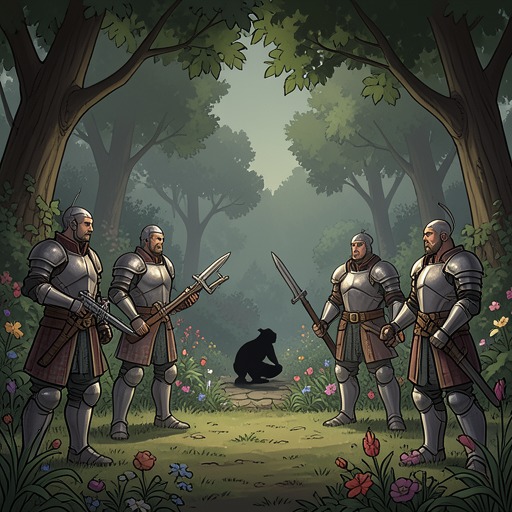
Once the conflict becomes open war, the Heavenly Host is mobilized under Michael and Gabriel. A divine voice commands them to attack the rebellious multitude and drive it from Heaven into Tartarus. The order is military in its precision: the loyal forces are to be ranged in thousands and millions, equal in number to the Rebel Angels, and led by the princes of the celestial armies. Their cause is explicitly identified as the cause of God and the Son of God.
The army advances in an irresistible square of union. Its ranks remain unbroken across hills, valleys, woods, and streams because the Angels march above the ground, carried by the air. Their movement recalls the orderly flight of birds summoned over Eden, but the scale is vastly greater: they cross many provinces of Heaven, each many times larger than the earthly world. The image joins natural order and military discipline, making the Host’s solidarity appear both organic and deliberately organized.
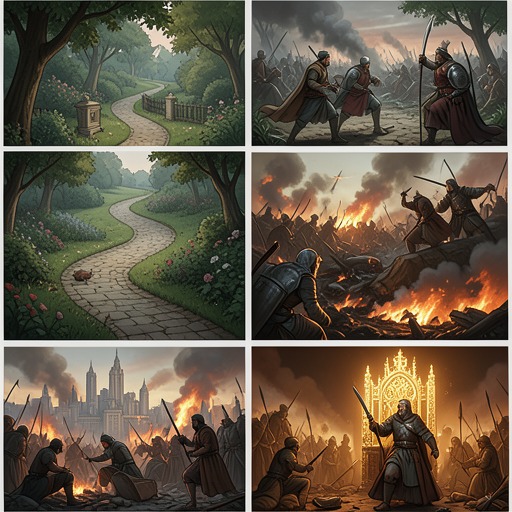
The first stages of the battle expose the destructive ingenuity of both sides. The Rebel Angels tear up mountains and hurl them as weapons, turning Heaven into a landscape of mountains striking mountains. The violence threatens universal ruin until God, who has foreseen and permitted the tumult, assigns the decisive action to the Son of God. The Host’s warfare has exhausted what warfare can accomplish; only the Son’s superior authority can end the conflict.
The Son of God orders the loyal Angels to stand still and witness the judgment. Their service has been accepted, but vengeance belongs to him because the rebellion is directed against his kingship. He therefore refuses to let the Host claim the final victory through numbers. This moment clarifies the army’s subordinate function: it fights faithfully, but it does not possess ultimate judicial authority. The Son alone drives the Rebel Angels from Heaven, using thunder and divine force while deliberately withholding enough power to destroy them, since their appointed punishment is expulsion rather than annihilation.
Service in Creation and History
After the expulsion, the Host celebrates God’s purpose: from the evil of the rebellious Spirits, God will bring forth a better race to fill their vacant place. The Host’s military success thus becomes part of a larger providential design. It does not merely restore Heaven’s boundaries; it prepares the narrative space for the creation of humanity and for the history that will follow.
When the Son of God undertakes the Creation of the World, the Heavenly Host accompanies him. Cherubim, Seraphim, Potentates, Thrones, Virtues, and winged Chariots emerge from God’s armory, where celestial equipment has long been prepared for a solemn day. Heaven opens its everlasting gates to release the King of Glory, and the Host follows him to the shore of Chaos to witness the ordering of the unborn world. The Angels are therefore both attendants and witnesses: they do not create the world, but their presence frames creation as a public manifestation of divine power.
The Host also responds liturgically to creation. When light first appears, the celestial choirs fill the universe with joy, touch their golden harps, and praise God as Creator. The same collective body that fought in ordered ranks becomes a chorus capable of recognizing harmony in the created order. Its worship interprets creation, while its military discipline earlier defended the authority from which creation proceeds.
The Host’s historical service extends to humanity’s beginnings and future. Humanity is created in God’s image and entrusted with dominion over the living world, while the Heavenly Host remains the larger celestial community before which God’s purposes are enacted. After the human Fall, the Son of God intercedes for humanity, and God summons the blessed Angels to a synod so that they may hear his judgment concerning mankind. Their assembly becomes a deliberative audience for divine justice and mercy, linking celestial governance to human suffering and redemption.
Guardianship and Narrative Significance
The Host’s later role is protective as well as judicial. God commands Michael to take chosen flaming warriors from among the Cherubim and drive Adam and Eve from the Garden of Eden, while placing a Cherubic watch and a wide-waving sword of flame at the eastern entrance to guard the Tree of Life. The expulsion is severe, but the command also prevents further misuse of immortality and protects the sacred garden from Spirits foul. The Host therefore enforces a boundary that is both punitive and preservative.
In the poem’s political theology, the Heavenly Host provides the positive counterpart to the Infernal Council. Its order is founded on God’s decree, and its ranks are presented as compatible with dignity when they remain oriented toward the Son of God. Human dominion over beasts, fish, and fowl is distinguished from human domination over other humans; likewise, celestial hierarchy is defended as legitimate when it reflects created order rather than arbitrary usurpation. Against Satan’s claim that freedom requires the absence of a monarch, the Host dramatizes a different model in which unity, obedience, and glory are mutually reinforcing.
Its significance also lies in the tension between collective grandeur and individual conscience. The Host is innumerable, richly ranked, armed with celestial weapons, and capable of moving as one body, yet its decisive moral test is concentrated in Abdiel’s solitary opposition to Satan. The organization can embody harmony only when its members freely align themselves with truth. The Host’s greatest victories therefore depend not simply on force or multitude but on the distinction between obedient freedom and rebellious self-assertion.